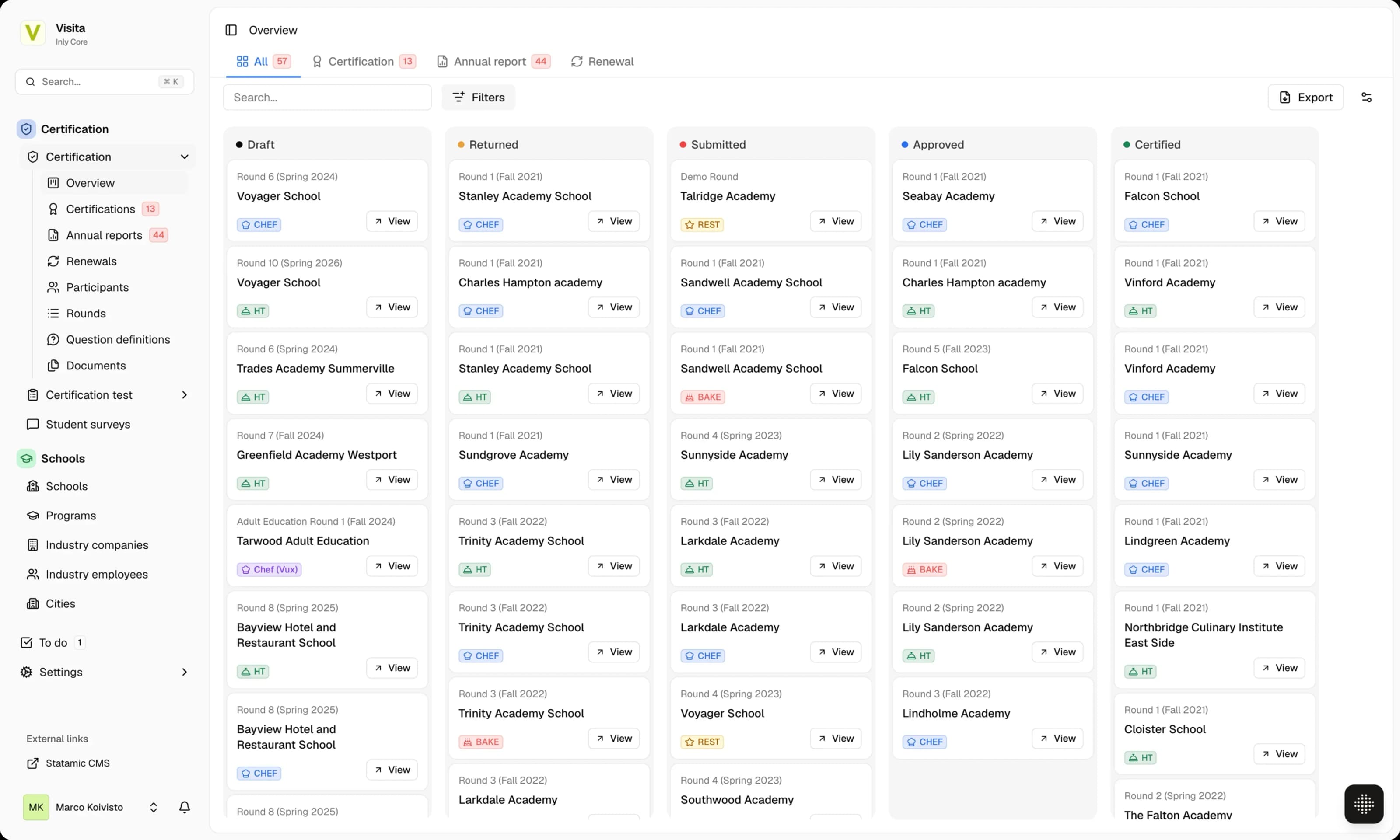
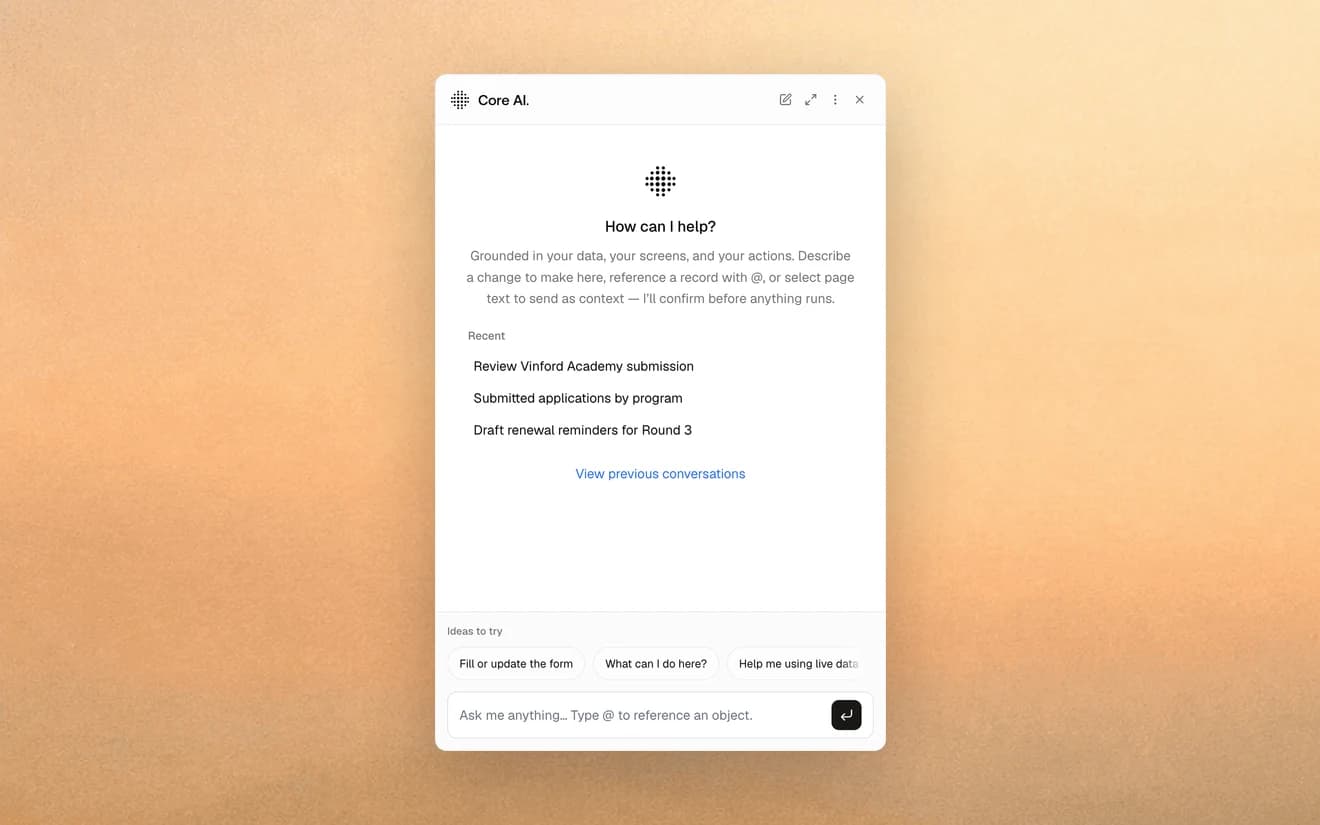
Berners' sales desk, on Core.
Leads arriving from Blocket, Wayke, Bilweb, Tradera, the website, email, and the phone — into a sales organisation split by brand and by town, with no way to tell which channel actually sold a car. Today every lead lands in one place, routed to the right seller, with a clock on it. Berners' own numbers: full traceability across the sales process, and no missed leads.

Berners sells and services cars across the north of Sweden — dealerships in Östersund, Sundsvall, Åre, Härnösand, Sollefteå, and Sveg, several car brands, and the workshops that come with them. It's a family business with a long history in the region. This story is about one part of it: the people who sell the cars. Every inquiry they get has a clock on it. Answer late and the customer buys from someone else.
The buyers don't arrive through one door. A lead might come in through Blocket, Wayke, Bilweb, or Tradera — the online marketplaces where Swedes buy and sell cars — through a form on Berners.se, by email, or as a phone call.
The seat Berners was in
Before, each of those channels was its own island. A seller watched the marketplaces they happened to watch and the inbox they happened to own. A lead that landed in the wrong place, or after hours, or while someone was on holiday, sat there. Whether it got picked up at all depended on who was looking and when.
And this is not one desk with one seller at it. Berners' sales organisation is large enough to be split two ways at once — by brand, and by town. A Skoda inquiry in Östersund and an Audi inquiry in Sundsvall belong to different people. So every lead needed sorting before it could be worked, and the sorting was done by whoever happened to see it first.
What that setup couldn't produce was a record. Nobody could say how many leads came in last month, how many got an answer, how fast, or which of the marketplaces was actually producing sales rather than just volume. The channels all cost money and the split between them was decided on feel, because there was nothing else to decide it on.
They weren't starting from nothing. HubSpot does the marketing work well and stays where it is. As the sellers' tool, though, it was never the right fit — more software than the job needs, and an interface shaped around the system rather than around a day in a dealership. What Berners needed for sales was a sales tool, not a CRM.
What Berners did instead
So Berners had us build that layer, shaped around how they already work. We host it, secure it, and keep extending it as new needs surface; the day-to-day is theirs.
Most of what Berners does didn't change. The same sellers, the same brands, the same way they talk to customers. What's new is the layer underneath: one data model where every lead, from every channel, becomes the same kind of record — and one set of rules for what happens to it next.
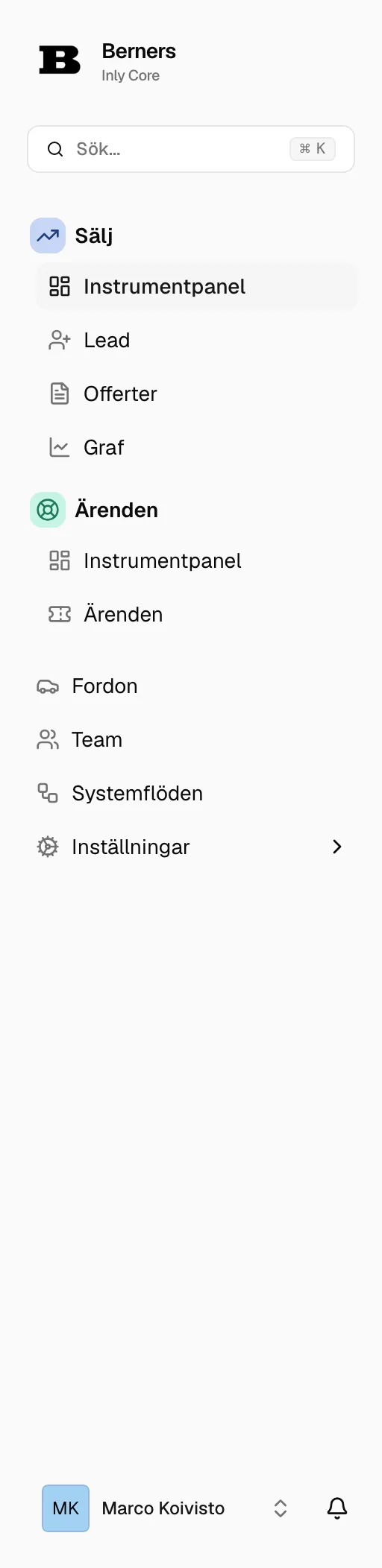
What it looks like now
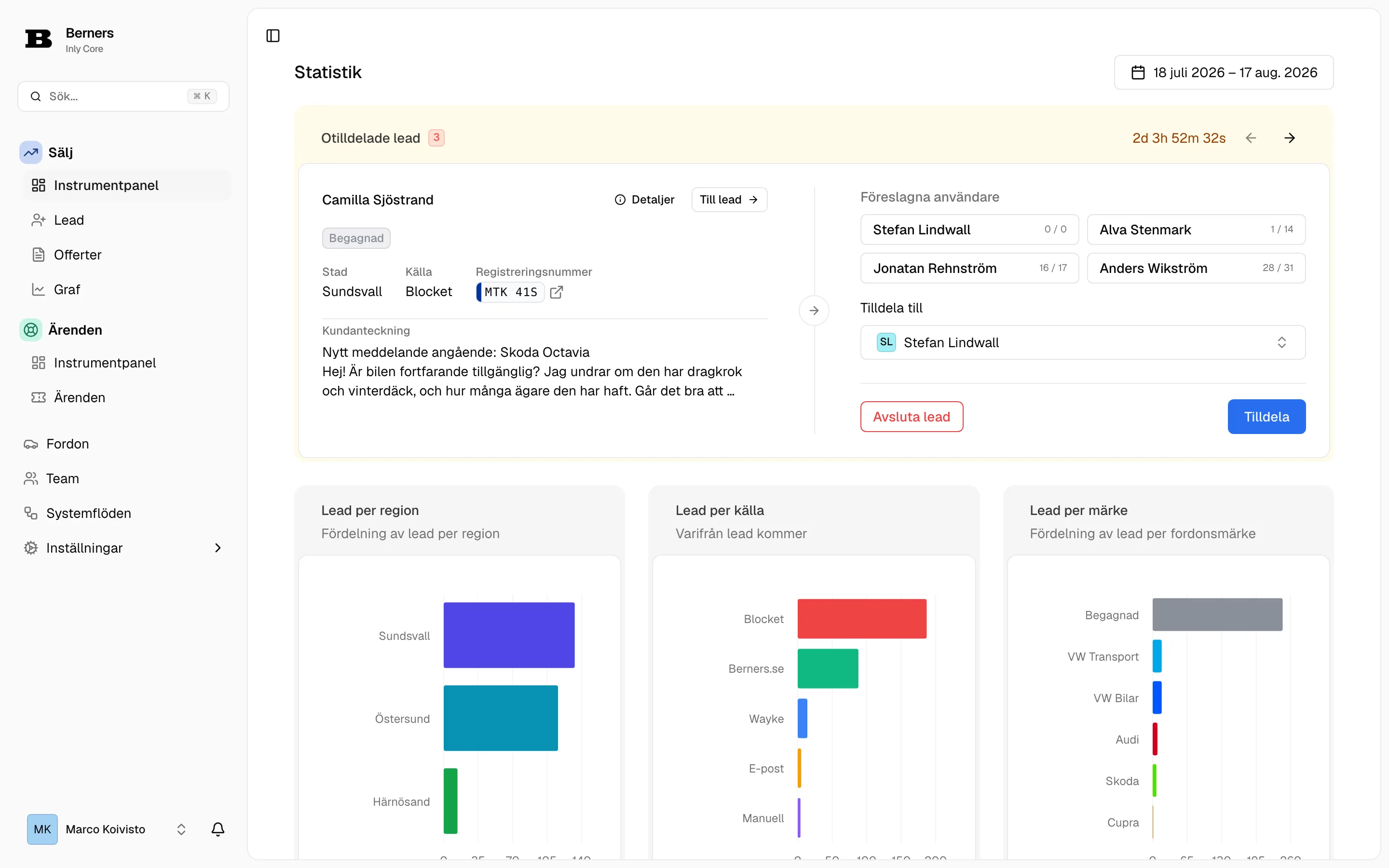
A lead arrives — say, an email about a used car listed on Wayke. Core reads it, pulls the vehicle's details from the listing and the registry by its plate, works out which brand and which town it belongs to, and routes it to a seller who handles that brand in that region. The seller opens one record and sees everything: the customer, the car, the message, and any calls that have already happened on the line. They call back, and the call logs itself against the lead. When it turns into a quote, then a sale, the record moves with it.
That works because the layer is wired into the tools Berners already runs on. Telavox puts the phone calls on the lead. Outlook puts the mail there. SAMS, the dealership system, is where the deal itself lives. Together they close the loop: the whole path from first inquiry to signed customer is visible in one place, without anyone stitching it together by hand.
A lead also doesn't get to sit. Every one of them lands with a clock running, and if nobody has picked it up in time it escalates until someone does. The timer isn't the point; the point is that someone who asked a question on a Saturday evening hears back before they go and ask a dealership down the road.
Nothing is re-keyed, and nothing depends on a particular person happening to be watching a particular inbox. A lead is assigned the moment it lands, or sits in a shared queue the whole team can see and claim from. The AI read of each inbound message — pulling out the name, the phone number, the plate — is a first pass a person then works from, not a decision it makes on its own.
What that adds up to, in Berners' own numbers:
What the statistics opened up
Once every lead is a record, counting them is trivial — and the counting is where the second half of the value showed up. Berners can now see where leads come from, which sources turn into signed deals rather than just volume, where in the process they stall, and when they arrive. A lot of them arrive between seven and nine in the evening, which is precisely when a dealership is shut. Knowing that, you can staff for it digitally instead of finding the messages the next morning.
The same view changes where the money goes. The sources that generate the most business are the ones that get the budget, and that's now an argument with numbers behind it rather than a hunch. Leads that didn't buy this time don't vanish either — they stay a leads bank to work later.
What changed inside the team
The numbers matter, but the quieter change matters more. The sales managers can see the whole pipeline at once instead of each watching their own corner of it. No lead lives or dies in one person's inbox. When someone is sick or on holiday, their leads don't go dark — they're in the same queue as everyone else's. A new seller is onboarded into the system itself, not into who-watches-what folklore that used to live around it.
And the sellers use it, which is the part that failed last time. It's built around how they actually sell, in their language, with the views the job needs and not the ones it doesn't. Sales was the first flow to move onto the layer. It won't be the last — adding the next area is now more a decision than a project.
“We've gone from leads scattered across half a dozen platforms to all of them in one place, assigned to the right seller and answered in time. We can finally see which channels actually sell cars, so the budget goes where the business comes from. And it's built on how our sellers really work, in Swedish, with the words we use in this industry — which is why it's actually being used.”
Clara Söderberg
Digital affärschef, Berners
Beyond Berners
Berners' shape isn't rare. Leads arriving through more channels than any one person can watch, a sales floor split by brand and by geography, no way to tell which channel is paying for itself, and a system that asks more of the people using it than it gives back — a lot of operations end up there. Sometimes the fix isn't a bigger licence, but a thinner layer built around the work you actually do, in the words you already use. What Berners did is one path through it, not the only one.
If any of this is familiar, you can read more about the work we do and the Deliveries we ship on Core.