
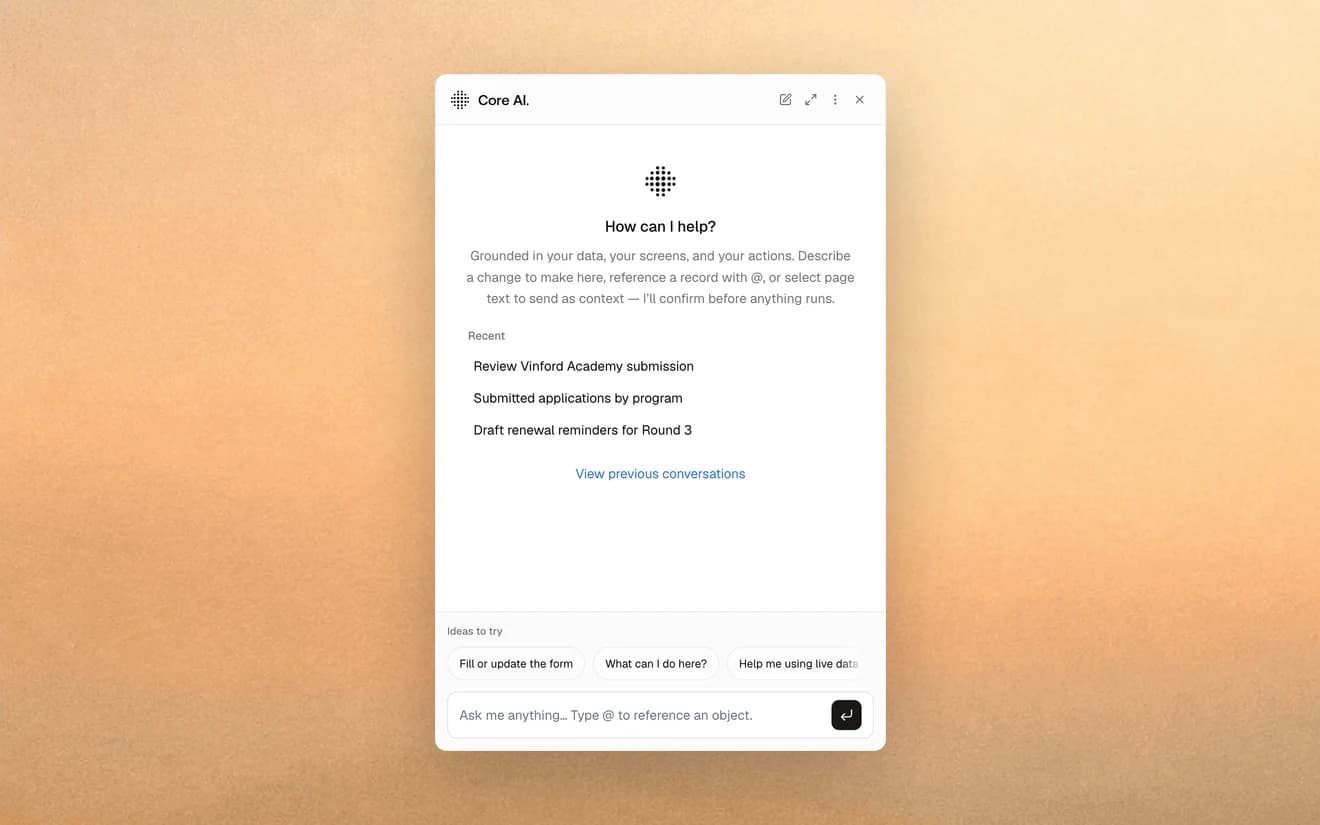
Replace the tools that don't earn their place. Connect the ones that do.
Not every system in your stack deserves its license. Where a tool is expensive for what it returns, or fights the way your business runs, Core takes over that work. Where a system does its job, Integrations connects it to Core, so data flows where it needs to go and nobody bridges the gap by hand. Your ERP, your accounting, a field tool the crew likes.















Every system is an island. And someone is always manually building the bridge.
Your ERP holds the financial truth. Your CRM holds the customer truth. Your scheduling tool holds the operational truth. Each one is correct in its own context — and inconsistent in every other.
Someone is always reconciling them. Pasting between systems, checking which version is right, fixing the bridge when one side updates. That work doesn't appear on any roadmap, but it's the largest hidden cost in most operations.
Connect what you keep. Core covers the rest.
Pre-built connectors
Common business systems already mapped, ready to plug in.
API & webhook support
Open access for anything not pre-built.
Bidirectional sync
Updates flow both ways, automatically.
Data enrichment & normalisation
Clean and align data on the way in.
Event-based triggers
Changes anywhere can drive workflows everywhere.
Integration monitoring & alerting
Know the moment something stops talking.
Integrations is where Core meets the rest of your world.
Once your tools talk through Core, your data stays consistent, your workflows span the whole stack, and your portal stays current with whatever moved in your ERP this morning.
The connections become infrastructure, not glue. New systems plug into the same model rather than starting their own.
We sort the stack with you before we connect anything — and we'll say so when a piece should go.
We audit what you have first — what each system owns, what it shouldn't, and where the manual reconciliation lives. Then we sort the stack together: what moves onto Core, what stays and gets connected, what can be retired. From there, pre-built connectors carry the load where they fit, and bespoke ones cover whatever's left.
Where a tool isn't earning its keep — too expensive for what it returns, fighting the way your business runs, or holding back the rest of the stack — we'll flag it and propose a path forward: absorb it into Core, swap it for a better-fit alternative, or keep it and work around its limits. Whichever path we take, we run it as a change-managed delivery, not a quiet swap behind the team's back.
Every connection is documented, monitored, and built to survive vendor updates — so the integrations you depend on don't quietly break the next time someone on the other side ships a release.