
Straight answers.
The questions that usually come up in the first conversations.
Core
What is Core?
Core is the platform Inly builds for small and mid-sized businesses to run their operations on. It replaces the software licenses a business doesn't need, with tools fitted to its domain: cases, forms, signing, quotes, orders, connects the systems it keeps, such as ERP and accounting, and gives the team, its clients, and AI one place to work. Sold as a fixed monthly subscription with unlimited users, operated end to end by Inly.
Who is Core for?
Small and mid-sized businesses with an operational core that have outgrown their systems. The base systems usually work: an ERP, a dealer system, a CRM, a webshop. Nothing holds them together: the same data is entered twice, core processes live in Excel and email, and clients have no way to serve themselves. The constraint on growth is operational capacity, not demand. It runs across sectors: vehicle dealers with several sites, e-commerce brands, member organisations, coworking, logistics, education, media.
Is Core about digitalisation or about AI?
Both, in that order. From the first flow, the business gets one shared foundation: data is entered once and is there for everyone who needs it. That is the same foundation AI needs to do real work, the whole context rather than extracts from separate systems. Once you run on Core, you are ready for AI without another project.
Can we use our own AI, like Claude or ChatGPT?
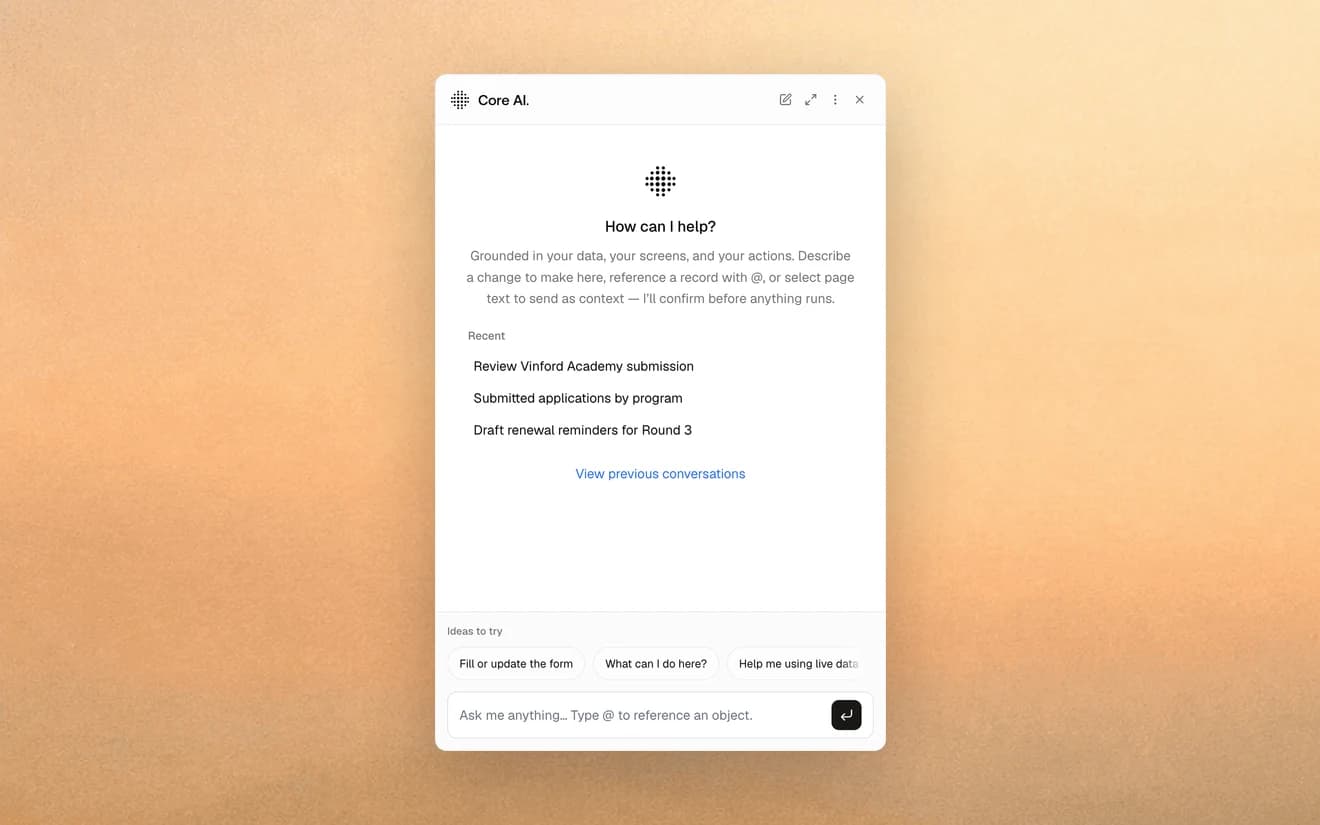
Yes. Core has an MCP server, so Claude, ChatGPT, Copilot or another assistant that supports MCP can connect to it. The assistant works with the access of the person who connected it and much the same tools as Core AI, so it can prepare a client call, look for patterns in your data or draft the next step. It can't write to Core directly: a change it proposes arrives as a request someone approves, and your rules apply as they do to everyone else. Your data then goes to the AI provider you chose, under your agreement with them. Core AI stays included for the work inside your flows.
Read about Core AIWhat does Core cost?
A fixed monthly fee for the platform — hosting, security, updates, support, Core AI, and unlimited users included. The price follows your business, not your user count, so it stays predictable as the team grows. There are two levels, and a few optional add-ons at fixed monthly prices; what separates the levels is how closely we work with you, not which features you get. An included allowance covers the usage that varies: AI, storage, email and SMS. Anything above it is billed on top. The work we build on the platform is scoped and priced separately as Deliveries, each with a Definition of Success agreed up front. We put concrete numbers on the table in the proposal after the first call.
How fast can we be live?
The first scoped Delivery is typically in production within 2–4 weeks — one flow, not the whole business at once, built from Core's existing building blocks and shaped around your process. From there you extend on the same platform, one process at a time, each Delivery faster than the last.
What support do we get?
Every subscription includes support with an uptime commitment and a shared channel straight into our team. Where the platform handles something business-critical, Priority support is an add-on: phone contact, shorter response times and evening on-call. At the higher level a named contact who knows your setup owns the relationship and the regular check-ins. The person you reach is a business developer, not a support desk.
Do we have to replace the systems we run today?
Only the ones that aren't earning their place. Core takes over the standard systems around your core business — CRM and case handling, booking, forms, signing, client and member portals, notifications — and connects the ones you keep. A system stays when your business runs on it, or when one department has a clear, bounded use for it. Then we connect it to Core rather than replace it. One you use for a fraction of what it costs can move onto Core. Data is entered once and flows automatically. We sort the stack with you before building anything: what moves onto Core, what stays, what can go.
What happens to our data if we leave Core?
You get your configuration and data in standard formats. Everything you have entered and configured is yours to take.
Compared
We already run an ERP — does Core replace it?
Usually not. Most of our customers keep their ERP for the few who need it and give everyone else tailored Core tools. Orders, invoices, and master data flow between the two automatically, so nothing is entered twice.
Read Core vs Business CentralCan Core replace our CRM?
Often. We replace a contact list and a pipeline with a sales flow built around how you actually sell — no per-seat licenses, in your own terms. A deep marketing setup can stay on, connected to Core, for as long as it earns its place. Berners moved its sales desk onto Core and kept HubSpot for marketing.
Read Core vs HubSpotCouldn't we just build this in Lovable?
For a prototype or a one-off internal tool — go ahead, it's a great way to find out what you need. The difference shows up in production: roles and audit trails, and an expert to call when your app breaks — the tool's support ends where your flows begin. That's the part Core is for.
Read Core vs LovableWhy not build custom software?
The tailored fit is the right instinct, but building from scratch means hiring a dev team and owning hosting, security, and maintenance forever. Core delivers the same fit from proven building blocks — live in weeks, run by us.
Read Core vs Custom softwareInly
Where is Inly based and where is data stored?
Inly is based in Stockholm and Gothenburg, with engineering in Sweden. Your data and backups are hosted in the EU by default, and Core is GDPR-aligned. The AI features use a provider outside the EU. They can be switched off for you if you need that, and your data is never used to train models. Security routines for access control, backups and restore, and incident handling are built against ISO 27001.