
Triggers, routing, approvals, and AI — so work moves without you pushing it.
Every operational process has moments where work stalls. Workflows eliminates those moments. Rules run instead of reminders. Handoffs happen automatically. Humans stay involved only where their judgment actually adds something.
Most processes don't fail because of bad decisions. They fail because work stops moving.
Manual coordination is the hidden cost of every operation — a constant low-level drag. The handoff waiting on a reminder, the approval pending a follow-up, the report that won't generate until someone clicks the right button at the right time.
It rarely shows up on a roadmap, but it's the first thing your team would describe if you asked what slows them down. Workflows is the part of Core that takes those moments off the team's plate.
The rules and triggers that move work without anyone pushing it.
Trigger-based automation
Events kick off the right next step automatically.
Routing & assignment rules
Work lands with the right person or system every time.
Approval flows
Decisions captured, routed, and logged.
Human-in-the-loop steps
Humans involved precisely where judgment adds value.
Deadlines & escalation
Track the clock on every commitment, surface risk early, escalate before something slips.
AI as a workflow participant
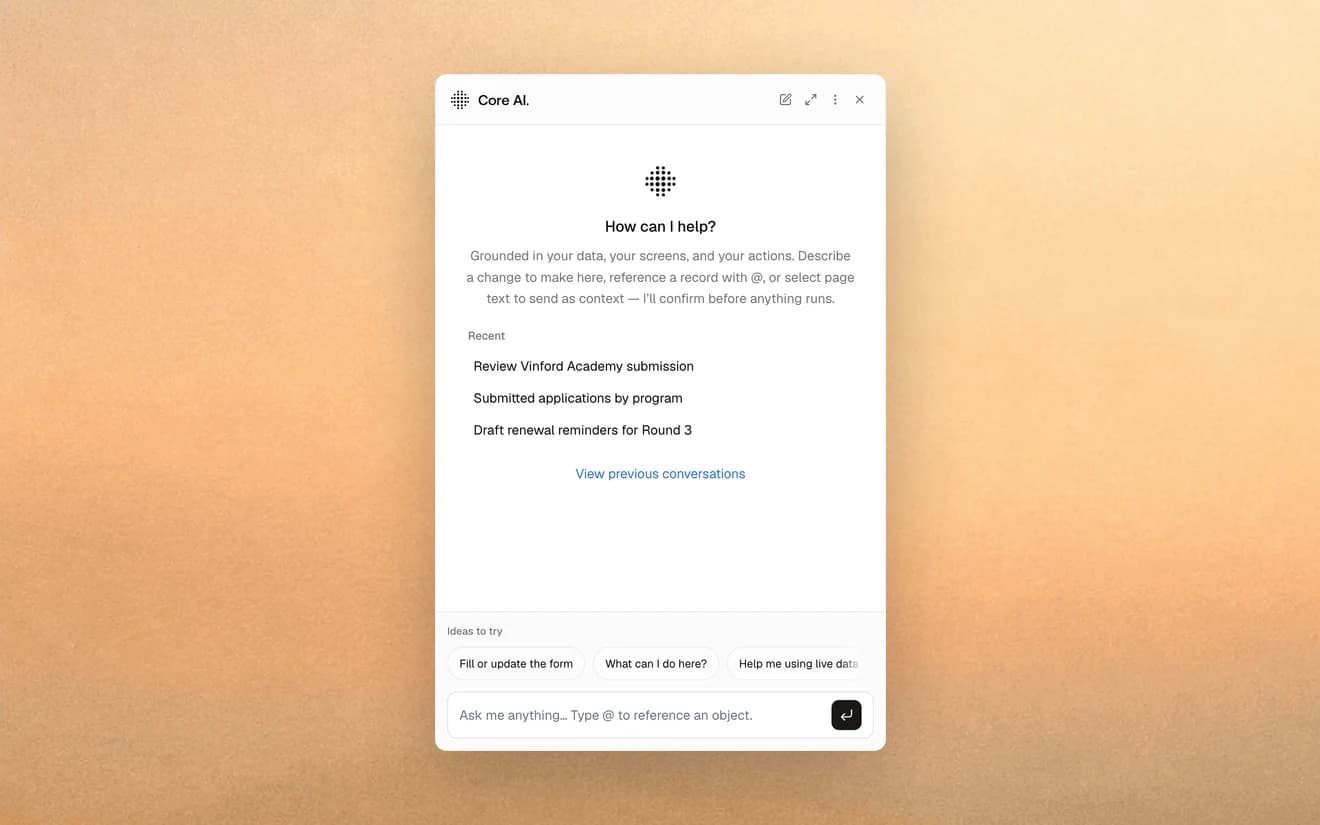
Core AI takes a step inside the workflow itself: a first read, a draft, a sort.
Audit trail & traceability
Every step recorded — what happened, when, by whom.
Workflows is the nervous system.
Workflows reads from Data, runs on Core's rules, and escalates to Applications when human judgment is needed. It extends outward through Integrations. A status change in your ERP can trigger a sequence that touches your CRM, your team, and a client — all in the right order.
Done well, the operation stops feeling like a stack of tools and starts feeling like one coordinated system.
Start with the process that breaks most often.
Pick the workflow where work stalls the loudest. Map it end-to-end, build it in Core, and test it against the edge cases that have tripped you up before.
The first automation is the hardest organisationally — there are new habits to form and old workarounds to retire. Subsequent ones compound: same data model, same patterns, same trust, applied to the next process and the one after.